

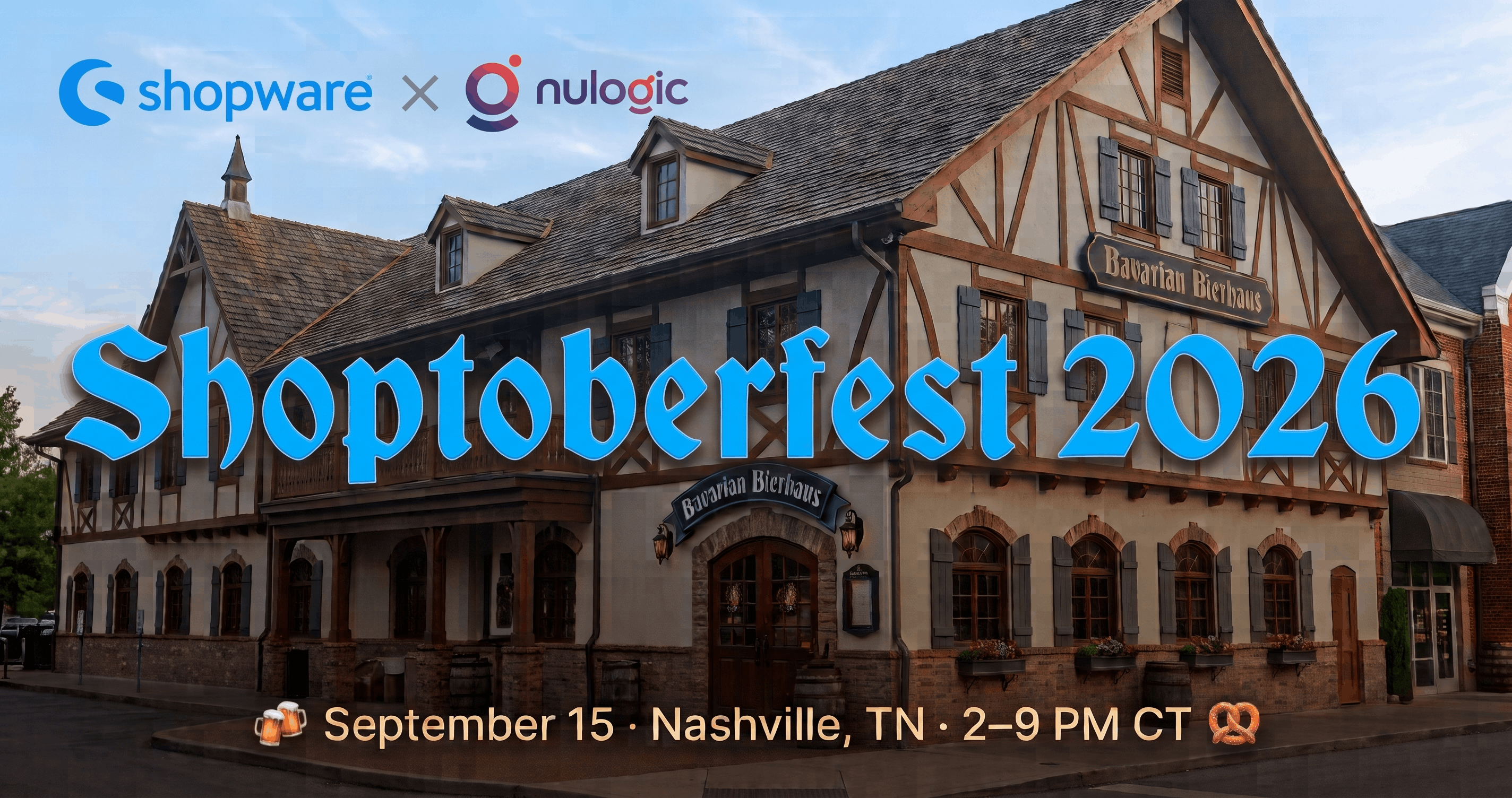
Shoptoberfest 2026
A different kind of commerce event
Shoptoberfest is built around merchants telling their own stories, and that shaped the whole day in Nashville. The NULogic team started with a Friends of NULogic breakfast, then spent the afternoon and evening at the Bavarian Bierhaus, where merchant talks, live interviews, and table-side conversations ran side by side.
Blue and white bunting, long wooden tables, and a few cowboy hats made for a room where people talked to each other, not just at each other. The format left room for that: short talks from merchants on the stage, then time at the tables to keep talking.

Shoptoberfest is about increasing the odds of serendipity by being around each other and talking.
Jason Nyhus, President and GM of North America, Shopware, in his opening remarks
Key takeaways from Shoptoberfest 2026
Five themes from the talks and conversations in Nashville, and how they connect to the work we do with retail and commerce teams.
The real critical path in a replatform is people, not platforms

UPPAbaby's Neil Gole opened his talk with a plain observation: "People don't fear technology; people fear the change that it essentially forces them to do." On UPPAbaby's global commerce rebuild, the budget conversation with the C-suite and board took about two weeks. Bringing roughly 40 stakeholders around the world along was the harder part. Many of them were experts in the way things had always been done, and early pitches about the technology went nowhere. What changed the conversation was showing each team how the shift would make their role more valuable and give them more to contribute.
Why it matters. Most programs plan carefully for integrations and data migration and leave buy-in to chance. Treating alignment as scheduled work gives a program a better chance of holding its plan.
In our work. The platform decision and the change plan deserve equal attention. It is a habit we bring to every commerce program at NULogic.
A direct channel is risk management long before it is a growth strategy
UPPAbaby ran a traditional wholesale model, with specialty retailers and department stores around the world, and ecommerce did not become a priority until 2022. The push came when a retail partner went bankrupt in 2021, putting roughly 25 to 30% of revenue at risk. The team's first response was to stand up 25 websites quickly, three of them commercial and the rest there to keep the brand present. It bought time. It was not the foundation the next five to ten years would need.
Why it matters. Brands with heavy wholesale or marketplace exposure carry the same kind of concentration risk. An owned channel built deliberately is a much stronger position than one assembled in a hurry.
In our work. NULogic helps brands move from wholesale-led or fragmented setups to a single, scalable direct channel, on platforms including Shopware and Salesforce Commerce Cloud.
Partners are tested by what the contract did not cover
"I was actually looking for partners that were willing to navigate this journey with me."
Neil Gole, UPPAbabyNeil said he has come to think the word "partner" gets used too loosely. Contracts protect both sides, but he wanted people who would stay with the project and share in the outcome. Over about a year and a half, he never once had to go back to the contract to hold anyone to a promise. The problems that mattered most were the ones nobody could have written into an agreement in advance.
One attendee's own recap pointed to the same theme, the relationship between platform, technology partner, and agency partner.
Why it matters. Vendor selection usually turns on capability and price. Asking how a partner behaved when a project went off script tells you at least as much.
In our work. We are proud that UPPAbaby counted NULogic among the partners on that journey. It is the standard we hold ourselves to on every engagement.
Choose the platform for the growth plan, not for today's operations
Questions worth asking before you choose
- Where do we expect revenue to be in five to ten years?
- Which regions, channels, and teams will the platform need to serve?
- What will we be working around if we stay where we are?
Neil tied the platform case directly to the revenue and growth UPPAbaby's leadership wanted to reach. If the company was serious about that scale, it needed a robust global infrastructure, and WordPress and WooCommerce were not going to carry it. The investment was significant for a company new to ecommerce, but he framed the decision around where the business needed to be over the next five to ten years.
Why it matters. A global platform has to serve operations, merchandising, and customer-facing teams across regions. That is why the stakeholder work in the first takeaway and the architecture work here belong in the same plan.
In our work. This is the conversation our teams have with retailers weighing a replatform, a headless architecture, or tighter integration across commerce, ERP, and data systems.
AI and agentic commerce will move at the speed of human readiness

Agentic commerce was on the agenda in Nashville, and one attendee's recap described it as an abundant topic. Jason Nyhus described the moment as "the fastest changing time in our e-commerce history." Neil's view, offered from the merchant's chair, was that AI, agentic commerce, and automation will keep moving faster than anything the industry has seen, and that every one of them depends on a human component. In his words, "technology doesn't solve for ego, it doesn't solve for fear, it doesn't solve for politics, and most importantly, it doesn't solve for trust."
Why it matters. The pilot is the easy part. Getting to something that runs in production depends on aligned stakeholders, trusted partners, and clear ownership of who decides what. The measurable value shows up when those pieces are in place.
In our work. That is how we approach NULogic's AI Hub: getting from pilot to production-grade agentic commerce, with governance and an operating model alongside the technology.

A customer's view from the stage
Neil Gole, VP, Digital Platforms and Operations at UPPAbaby, on what building a global commerce platform taught him about people.
UPPAbaby is a NULogic client, and Neil's Merchant Talk was the customer perspective we were most glad to have in the room. The technical story, the platform, payments, and hosting choices, is told in Shopware's UPPAbaby case study. The story Neil chose to tell in Nashville was about the people side: persuading leadership, bringing a global group of stakeholders along, and finding partners who stayed through the unplanned parts of the project. He thanked Shopware, NULogic, and BlueSnap for standing by the work.
What his session added to the day was a way of framing everything else we heard. The hardest parts of modern commerce programs are rarely the technical ones.
"Technology to me is a tool."
NULogic at Shoptoberfest 2026
NULogic sponsored Shoptoberfest 2026 alongside our partner Shopware. Our team spent the day with retailers, commerce leaders, partners, and other attendees, in conversations about commerce modernization, AI, customer experience, and what the next generation of digital commerce needs.
It was also a chance to hear a client tell its own story, and to spend time with the wider Shopware community that makes an event like this work.
- Mani Vadivel, Founder and CEO, NULogic
- Steve Nicholas, VP, Business Development, NULogic
- Mike Relich, NULogic Company Advisor and Tillys Board Member, who spoke in the Merchant Talks


Let's talk about what's next
If these questions are on your commerce roadmap, whether that is aligning stakeholders for a replatform, choosing the right partners, or moving AI from pilot to production, let's compare notes.
Get in touchWhat you will learn
Join us for an insightful webinar on the latest web technologies and trends!


Reserve your spot
Shoptoberfest 2026


Shoptoberfest 2026
Good conversations, real commerce challenges, and a closer look at where digital commerce is heading.
A different kind of commerce event
Shoptoberfest is built around merchants telling their own stories, and that shaped the whole day in Nashville. The NULogic team started with a Friends of NULogic breakfast, then spent the afternoon and evening at the Bavarian Bierhaus, where merchant talks, live interviews, and table-side conversations ran side by side.
Blue and white bunting, long wooden tables, and a few cowboy hats made for a room where people talked to each other, not just at each other. The format left room for that: short talks from merchants on the stage, then time at the tables to keep talking.
Shoptoberfest is about increasing the odds of serendipity by being around each other and talking.
Jason Nyhus, President and GM of North America, Shopware, in his opening remarks
Key takeaways from Shoptoberfest 2026
Five themes from the talks and conversations in Nashville, and how they connect to the work we do with retail and commerce teams.
The real critical path in a replatform is people, not platforms
UPPAbaby's Neil Gole opened his talk with a plain observation: "People don't fear technology; people fear the change that it essentially forces them to do." On UPPAbaby's global commerce rebuild, the budget conversation with the C-suite and board took about two weeks. Bringing roughly 40 stakeholders around the world along was the harder part. Many of them were experts in the way things had always been done, and early pitches about the technology went nowhere. What changed the conversation was showing each team how the shift would make their role more valuable and give them more to contribute.
Why it matters. Most programs plan carefully for integrations and data migration and leave buy-in to chance. Treating alignment as scheduled work gives a program a better chance of holding its plan.
In our work. The platform decision and the change plan deserve equal attention. It is a habit we bring to every commerce program at NULogic.
A direct channel is risk management long before it is a growth strategy
UPPAbaby ran a traditional wholesale model, with specialty retailers and department stores around the world, and ecommerce did not become a priority until 2022. The push came when a retail partner went bankrupt in 2021, putting roughly 25 to 30% of revenue at risk. The team's first response was to stand up 25 websites quickly, three of them commercial and the rest there to keep the brand present. It bought time. It was not the foundation the next five to ten years would need.
Why it matters. Brands with heavy wholesale or marketplace exposure carry the same kind of concentration risk. An owned channel built deliberately is a much stronger position than one assembled in a hurry.
In our work. NULogic helps brands move from wholesale-led or fragmented setups to a single, scalable direct channel, on platforms including Shopware and Salesforce Commerce Cloud.
Partners are tested by what the contract did not cover
"I was actually looking for partners that were willing to navigate this journey with me."
Neil Gole, UPPAbabyNeil said he has come to think the word "partner" gets used too loosely. Contracts protect both sides, but he wanted people who would stay with the project and share in the outcome. Over about a year and a half, he never once had to go back to the contract to hold anyone to a promise. The problems that mattered most were the ones nobody could have written into an agreement in advance.
One attendee's own recap pointed to the same theme, the relationship between platform, technology partner, and agency partner.
Why it matters. Vendor selection usually turns on capability and price. Asking how a partner behaved when a project went off script tells you at least as much.
In our work. We are proud that UPPAbaby counted NULogic among the partners on that journey. It is the standard we hold ourselves to on every engagement.
Choose the platform for the growth plan, not for today's operations
Questions worth asking before you choose
- Where do we expect revenue to be in five to ten years?
- Which regions, channels, and teams will the platform need to serve?
- What will we be working around if we stay where we are?
Neil tied the platform case directly to the revenue and growth UPPAbaby's leadership wanted to reach. If the company was serious about that scale, it needed a robust global infrastructure, and WordPress and WooCommerce were not going to carry it. The investment was significant for a company new to ecommerce, but he framed the decision around where the business needed to be over the next five to ten years.
Why it matters. A global platform has to serve operations, merchandising, and customer-facing teams across regions. That is why the stakeholder work in the first takeaway and the architecture work here belong in the same plan.
In our work. This is the conversation our teams have with retailers weighing a replatform, a headless architecture, or tighter integration across commerce, ERP, and data systems.
AI and agentic commerce will move at the speed of human readiness
Agentic commerce was on the agenda in Nashville, and one attendee's recap described it as an abundant topic. Jason Nyhus described the moment as "the fastest changing time in our e-commerce history." Neil's view, offered from the merchant's chair, was that AI, agentic commerce, and automation will keep moving faster than anything the industry has seen, and that every one of them depends on a human component. In his words, "technology doesn't solve for ego, it doesn't solve for fear, it doesn't solve for politics, and most importantly, it doesn't solve for trust."
Why it matters. The pilot is the easy part. Getting to something that runs in production depends on aligned stakeholders, trusted partners, and clear ownership of who decides what. The measurable value shows up when those pieces are in place.
In our work. That is how we approach NULogic's AI Hub: getting from pilot to production-grade agentic commerce, with governance and an operating model alongside the technology.
A customer's view from the stage
Neil Gole, VP, Digital Platforms and Operations at UPPAbaby, on what building a global commerce platform taught him about people.
UPPAbaby is a NULogic client, and Neil's Merchant Talk was the customer perspective we were most glad to have in the room. The technical story, the platform, payments, and hosting choices, is told in Shopware's UPPAbaby case study. The story Neil chose to tell in Nashville was about the people side: persuading leadership, bringing a global group of stakeholders along, and finding partners who stayed through the unplanned parts of the project. He thanked Shopware, NULogic, and BlueSnap for standing by the work.
What his session added to the day was a way of framing everything else we heard. The hardest parts of modern commerce programs are rarely the technical ones.
"Technology to me is a tool."
NULogic at Shoptoberfest 2026
NULogic sponsored Shoptoberfest 2026 alongside our partner Shopware. Our team spent the day with retailers, commerce leaders, partners, and other attendees, in conversations about commerce modernization, AI, customer experience, and what the next generation of digital commerce needs.
It was also a chance to hear a client tell its own story, and to spend time with the wider Shopware community that makes an event like this work.
- Mani Vadivel, Founder and CEO, NULogic
- Steve Nicholas, VP, Business Development, NULogic
- Mike Relich, NULogic Company Advisor and Tillys Board Member, who spoke in the Merchant Talks
Let's talk about what's next
If these questions are on your commerce roadmap, whether that is aligning stakeholders for a replatform, choosing the right partners, or moving AI from pilot to production, let's compare notes.
Get in touch