

USA

The Architecture of Urgency: Turning Local Stores into Same-Day Delivery Hubs
How a specialty retailer with 1,000+ stores solved the "stranded inventory" problem by orchestrating Uber Direct, Salesforce Commerce Cloud, and Manhattan Active Omni to offer same-day delivery — without building a single new warehouse. A deep dive into decoupled architecture, mixed-fulfillment carts, and the real ROI of hyper-local fulfillment.
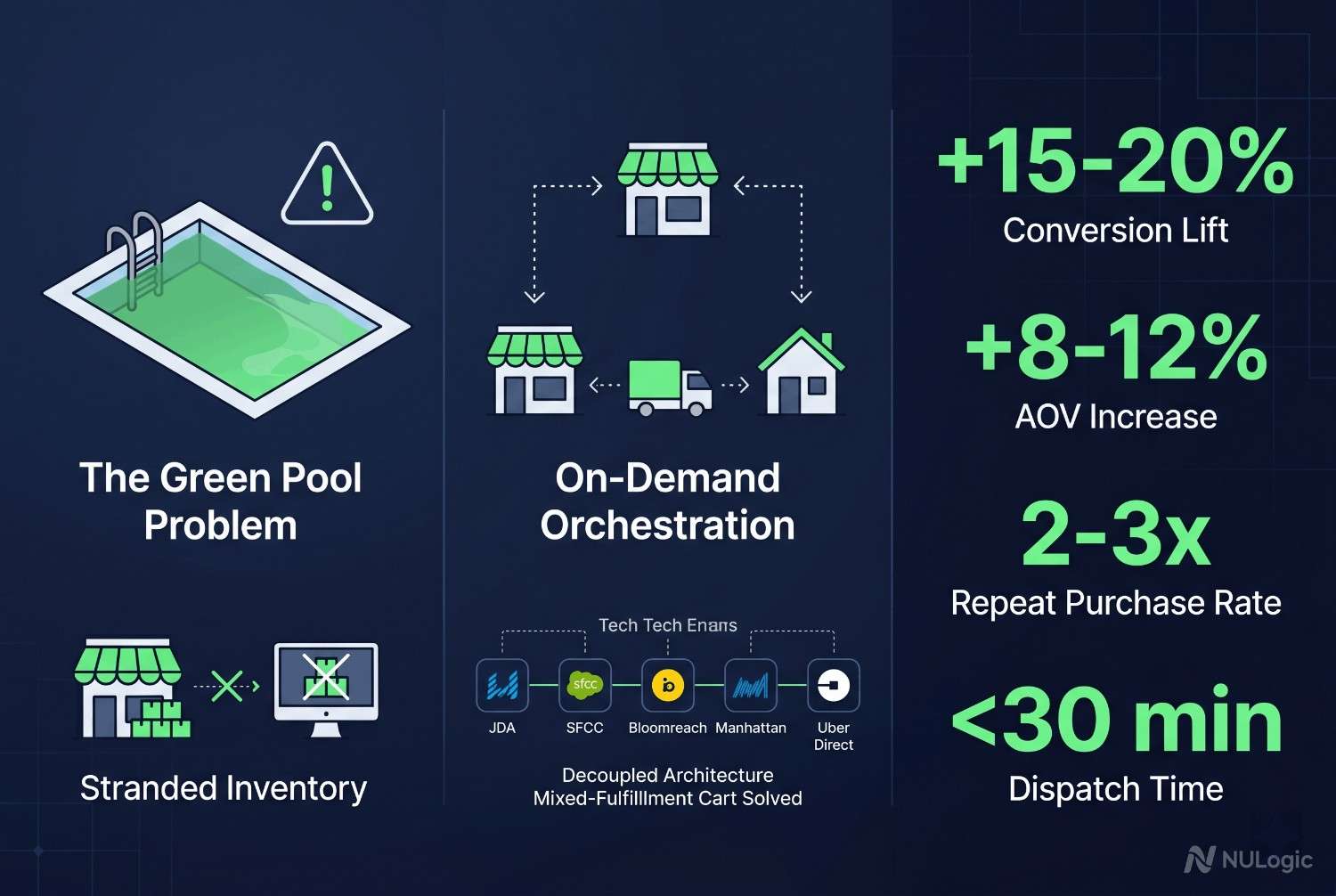
In the world of retail, there are two types of purchases: the planned and the urgent. If a customer is browsing for a new patio set, a 3–5 day shipping window is perfectly acceptable. But what happens when that same customer wakes up to a "green pool" on the morning of a Saturday party, or discovers a broken pump mid-summer?In these crisis moments, standard shipping is a failure. For a specialty retailer in the pool and spa category, these urgency-driven moments are the heart of the business. When the pool is green, the customer doesn't need a solution next Wednesday; they need it today. Historically, if the digital storefront couldn't promise immediate relief, that customer would pivot to a local competitor or a marketplace that could.The challenge is clear: How can a retailer with a massive physical footprint provide Amazon-level delivery speed without the multi-billion dollar capital expense of building new distribution centers? The answer lies not in more warehouses, but in smarter orchestration of the assets you already own.

For modern retail, delivery speed has evolved. It is no longer a back-end logistical detail; it is a primary feature of the product itself. This is especially true for "urgency-driven SKUs"—chemicals, repair parts, and critical equipment. In these categories, the delivery window is the competitive moat. If you can’t deliver it "now," the product’s value to the customer drops to zero.“In our category, speed is part of the product. If a customer’s pool is green today, they don’t need it Wednesday — they need it now. Same-Day Delivery let us meet customers in that moment without rebuilding our store footprint.” — Digital Commerce Leadership, the Retailer
Many omnichannel retailers suffer from "stranded inventory." This is stock that is physically sitting in a local store—perhaps only five miles away from a customer—but remains completely invisible to that customer's digital shopping experience. To the website, that inventory might as well be on the moon.NULogic’s solution flips this paradigm by turning every physical store into a "digital fulfillment node." By making the local store's shelves visible to the digital channel, the retailer transforms a traditional brick-and-mortar asset into a high-speed hub for home delivery. It is vital to distinguish this from traditional Ship-from-Store (SFS) models. Standard SFS relies on traditional carriers and 2-3 day windows, essentially treating a store as a mini-warehouse. We implemented On-Demand Orchestration , which leverages local store clusters for immediate, last-mile delivery. Instead of committing massive capital expenditure (CAPEX) to acquire land and build new centralized warehouses, retailers can leverage existing leaseholds. It shifts the focus from building physical infrastructure to building a robust digital layer that resolves local supply against local demand in real-time.
The most significant barrier to same-day delivery is the "Mixed-Fulfillment" cart. Modern shoppers don't think in logistics; they just want their items. A single order might contain a bulk item for standard shipping, an accessory for Buy Online, Pickup In-Store (BOPIS), and a chemical treatment for Same-Day Delivery (SDD).Most eCommerce platforms struggle here, often forcing the customer to split the order or blocking specific delivery methods entirely. NULogic engineered the orchestration layer between Salesforce Commerce Cloud (SFCC) and Manhattan Active Omni (MAO) to handle line-item level fulfillment state-switching .Crucially, we moved away from BOPIS-style logic. While BOPIS looks at a single store for pickup, SDD requires multi-store availability logic that checks a cluster of stores within a specific ZIP-aware radius. To prevent the cart from "blocking" if logistics math changes during the session, we ensured that the OMS (Manhattan), not the storefront, owns the final store assignment. This frictionless checkout is the key to preventing cart abandonment during complex transactions.

The technical "Wow Factor" of this solution is its decoupled architecture. Rather than building a rigid silo, the system uses specialized platforms for specific tasks. A critical technical safeguard is the late-stage execution of the Uber quote. The system triggers the Uber Direct API at the final stage of checkout to capture a delivery quote valid for 30 minutes, preventing stale pricing and protecting margins.The orchestration is propagated across five key systems:
The shift to hyper-local fulfillment isn't just about customer satisfaction; it's a proven driver of business growth. Based on a hyper-local fulfillment case study, the transition to a same-day fulfillment powerhouse yields measurable financial and operational outcomes:

It's not a logistics failure — it's a perception failure. Most retailers already own the solution: thousands of local stores stocked with exactly what customers need, right now. The missing piece is orchestration.
No. By decoupling the frontend, inventory logic, and last-mile delivery — and by treating speed as a product feature rather than a shipping detail — any retailer with a physical footprint can offer same-day delivery without building a single new warehouse.
It's not just in conversions (+15–20%) or AOV (+8–12%). It's in becoming the answer to every customer's "I need it today" moment. In urgency-driven retail, that's the only competitive edge that matters.
Audit your stranded inventory, enable store-level visibility in your eCommerce platform, and integrate a decoupled last-mile service (like Uber Direct) with your OMS.
.png)
.png)





.webp)

